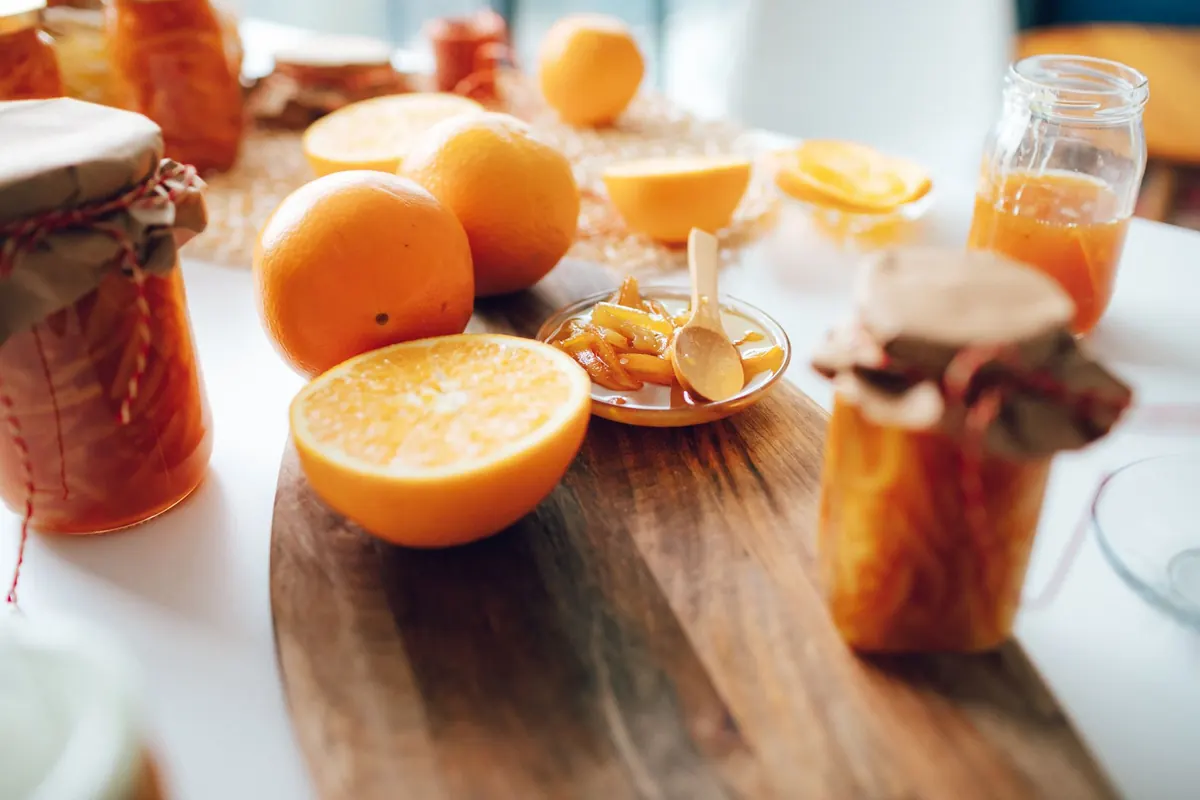
Seville oranges show up for a few short weeks each winter, and they are not oranges you would want to eat raw. They are bitter, sharp, pithy in the best way, and loaded with enough pectin to turn a pan of water and sugar into something that trembles on toast. If you have ever stood in a shop weighing a net of knobbly orange fruit and wondering whether marmalade is worth the trouble, here is the honest answer: it is slow, it is not difficult, and the first jar you open in November will make you want to do it again.
This guide is for a first batch. One kilogram of fruit, a few hours at home, and enough marmalade to see you through the year.
Choose Your Seville Oranges Carefully
Seville oranges are bitter oranges, the same fruit used for orange marmalade since at least the eighteenth century. Their season generally runs from late December into February, sometimes a little longer. They are usually sold loose or in nets, and unlike sweet oranges, they are rarely waxed, which matters because you are eating the peel.
When you are choosing, look for fruit that feels heavy for its size. Weight means juice. The skin should be taut and slightly glossy, with no soft brown patches or damp spots. A few marks are fine. What you want to avoid is fruit that feels light and spongy, because that fruit will have thick, dry pith and little juice.
If Seville oranges have finished for the season, you can make a decent marmalade with a mix of sweet oranges and lemons, or with other bitter oranges, but the flavour will be sweeter and less assertive. There is no substitute for the real thing, only a compromise.
Gather Your Equipment First
Marmalade is forgiving, but it does punish the wrong pan. Aluminium and uncoated iron react with the acid in the fruit and give the finished preserve a metallic taste. Use stainless steel or enamelled cast iron, and make sure it is deep. A good rule is that your pan should be no more than a third full when you start boiling, because the mixture rises dramatically once the sugar goes in.
- A large preserving pan, stainless steel or enamelled
- A long-handled wooden spoon and a ladle
- A sharp knife and a clean chopping board
- A square of muslin or cheesecloth, tied into a bag
- A jam thermometer (helpful, not essential)
- Two or three saucers, kept in the freezer
- About six 450g jars, sterilised, with lids and wax discs
For one kilogram of Seville oranges you will need roughly two litres of water and two kilograms of granulated sugar. Do not be tempted to cut the sugar. It is not there only for sweetness; it is what preserves the marmalade and helps it set.
Prepare the Fruit and Shred the Peel
Wash the fruit well, then halve each orange across the equator and squeeze the juice into your pan. Keep every pip and every scrap of membrane: pips are pectin, and pectin is what makes marmalade set. Tie the pips, membranes and any loose pith into your muslin bag and drop that into the pan too.
Now cut each empty shell into quarters and decide how thick you want your shred. Fine shred is elegant and slow to prepare; thick-cut gives you chewy, generous pieces that look handsome in the jar. For a first batch, aim for something in the middle, roughly the width of a matchstick. Stack a few pieces at a time, press them flat, and cut with a sharp knife. A mandoline sounds efficient but tends to crush the peel into uneven, ragged strips.
Add the shredded peel to the pan along with the water. At this point the pan will look like far too much liquid and far too little fruit. Trust it.
The First Boil: Softening the Peel
Bring the pan to a simmer, then reduce the heat and cook gently, uncovered, for about one and a half to two hours. The peel needs to become completely tender, so that a piece squashed against the side of the pan collapses without any resistance. If it still has a chalky bite, keep going. Top up with hot water if the level drops below the peel.
If you are short of time, you can soak the shredded peel and its water overnight instead, then simmer for a shorter period the next day. The result is very slightly softer in flavour, but perfectly good.
When the peel is ready, lift out the muslin bag and squeeze it hard against the side of the pan to extract all the pectin-rich liquid. Discard the bag.
Add the Sugar and Boil Hard
Warm the sugar in a low oven, which keeps the boil from stalling when it goes in. Take the pan off the heat, add the sugar, and stir until every grain has dissolved. Run the spoon across the bottom of the pan; if you can feel grit, keep stirring.
Once the sugar has dissolved, turn the heat up and bring the pan to a fast, rolling boil. Stop stirring now. Depending on your pan and your fruit, setting point usually arrives somewhere between fifteen and thirty minutes. Watch the surface: the bubbles get smaller and glossier, and the mixture starts to look like liquid amber rather than orange juice.
Test the Set Before You Pot
Start testing after about twelve minutes of hard boiling, and keep the pan off the heat while you test.
- The wrinkle test. Drop a teaspoon of marmalade onto a chilled saucer and put it back in the freezer for a minute. Push the edge of the puddle with your fingertip. If it wrinkles and holds, it is set. If it slides, it is not.
- The flake test. Lift a spoonful and let it cool for a moment, then tip it. Set marmalade falls from the spoon in a sheet or a flake rather than a thin stream.
- The thermometer. A reading of about 104 to 105°C is a reliable sign, though the wrinkle test is more certain.
If the marmalade is still loose, return it to the heat for three or four minutes and test again. If you overshoot and it sets rock-hard, stir in a little boiling water and reboil briefly.
Potting, Sealing and Storing
Let the pan stand for ten to fifteen minutes before potting. This allows the shred to distribute evenly instead of floating to the top of every jar. Fill hot, sterilised jars to within half a centimetre of the rim, wipe the rims clean, and seal while hot. A wax disc under the lid is traditional and harmless.
For genuinely shelf-stable marmalade, process the sealed jars in a boiling water bath, covered by a few centimetres of water, for ten minutes for 250ml jars. If you would rather skip that step, the marmalade is still fine, but keep the jars in the fridge and eat them within a month or so.
Store in a cool, dark cupboard and label with the date. Properly sealed marmalade keeps for a year or more. Once opened, refrigerate it. If a jar grows mould, smells fermented, or fizzes when you open it, throw it out without regret.
Your First Batch, and What Comes Next
Expect about five or six jars from a kilogram of fruit. Expect the colour to be brighter and less uniform than the shop version, and expect some peel to sit near the top. None of that is a fault.
Do not be discouraged if your first batch comes out slightly runny. Call it Seville orange syrup, pour it over pancakes, and try again next January with a little more boiling time. Once you have the rhythm, the variations come easily: a slug of whisky, a knob of ginger, a handful of rosemary, a batch cut thick and dark. Start with one plain batch, and let the fruit tell you what it wants.
Photo: serenasampson / Pixabay